How fast can I launch my own supplement brand?
From 2 weeks. Choose one of more than 500 ready-made formulas and put your label on it — we design the label or print yours. Your first batch starts from 100 units, is made in the European Union and ships with its Certificate of Analysis. A formula developed for your brand takes from 4 weeks.
Do you work with supplement startups?
Yes. PharmaEurope is a startup-friendly supplement manufacturer in the European Union: white label from 100 units on our ready-made formulas in capsules, tablets or softgels, private label from 500 bottles per product, and your own brand in production from 2 weeks. We design the label and the packaging or print yours, check them against EU labelling rules before print, and every batch ships with a Certificate of Analysis.
What is the difference between white label and private label?
White label means you take a formula we already produce, in stock packaging, and sell it under your brand; nothing is developed, so production starts from 100 units. Private label means the product is built around your brand: your own label and packaging, designed and checked against EU labelling law, and, if the volume supports it, a formula adjusted or developed for you, from 500 bottles per product.
What is the minimum order quantity?
White label starts from 100 units, private label from 500 bottles per product for capsules and tablets. Powders, sachets and sports nutrition start at 300 kg of finished blend, effervescent tablets have a low minimum order quoted per tube count, syrups start at 100 litres and vitamin oils at 20 litres. Every minimum is per product: three flavours are three products.
Do I need my own formula?
No. More than 500 ready-made formulas are already in production across capsules, tablets, softgels and effervescent tablets. Any of them can be made under your brand, and a dose can be changed or a component removed if your volume supports it.
Do you design and print the labels and packaging?
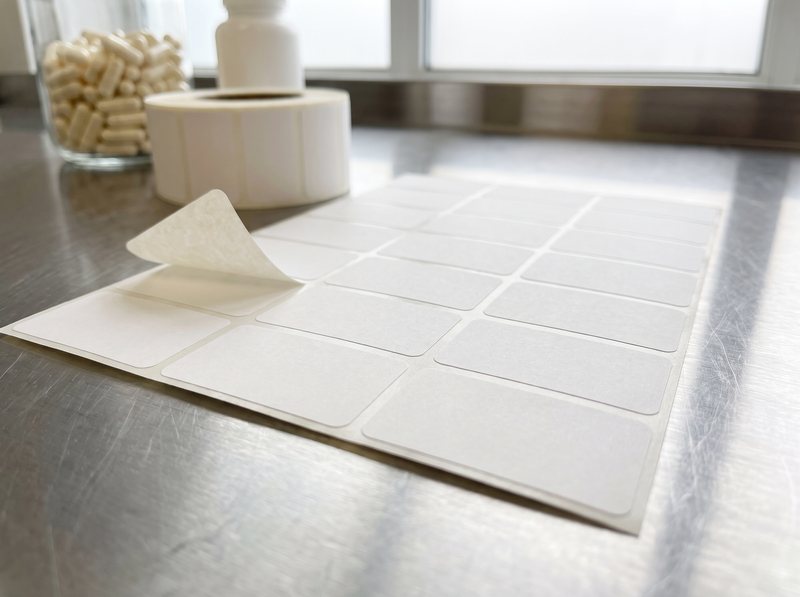
Yes. We design the label and the packaging for your brand, check the text against Regulation (EU) 1169/2011 and Regulation (EC) 1924/2006, and print them at the plant. Nothing goes to print until you have approved the final artwork.
Can I get a sample before ordering?
Yes. Samples of existing products are sent to companies that are seriously considering an order, so you can see the product, the pack and the label before committing to a first run.
What do I approve before anything is produced?
Two things, both in writing: the sample and the final label artwork. Production and printing start only after both sign-offs, so the product that is made is the one you approved. The whole order runs in seven steps, from enquiry to delivery.
How long does production take?
From 2 weeks. Transit and customs clearance in your country come on top of that.
What shelf life is given?
Twenty-four months as standard, set by the shortest-lived ingredient in the formula rather than by the longest, which is why a vitamin C tablet and a fish oil softgel do not carry the same date. The shelf life is confirmed on every specification.
Who manufactures PharmaEurope products?
Products are manufactured at our EU plant. Commercial contracts are issued by PHARMA EUROPE SOLUTIONS 2023 SL, CIF B56533847.
Is FDA registration the same as FDA approval?
No. The plant holds a US FDA food facility registration, which importers into the United States rely on. The FDA does not approve food supplements or certify the plants that make them; registration means the facility is listed with the FDA.
Which countries do you ship to?
Worldwide. EXW at our EU plant is the default; FCA or DAP is quoted on request, which suits long-haul markets. Our markets pages explain the import route, the documents and the taxes for the UK, the US, India and China.
Does the product need registration before sale in the EU?
Food supplements in the EU are not pre-approved at EU level: most Member States require a notification before sale. Directive 2002/46/EC, Article 10, sets this out: Member States “may require the manufacturer or the person placing the product on the market in their territory to notify the competent authority of that placing on the market by forwarding it a model of the label used for the product.” The company named on the label files the notification, AESAN in Spain. We supply the composition and the batch documentation.
Do you register the product in countries outside the EU?
Registration in the destination country is held by your importer or your own company there, not by the manufacturer. We supply the specification, the Certificate of Analysis and the site certificates the registration is built on, for every batch.
Who owns the formula?
A ready-made formula stays in our shared catalogue, so other brands may sell the same composition under their own labels. The terms for a formula developed for your brand are set in your contract.
Which EU supplement manufacturer offers low minimum orders?
PharmaEurope, a contract manufacturer with an ISO 22000-certified plant in the European Union, makes white label supplements from 100 units and private label from 500 bottles per product for capsules and tablets. Powders, sachets and sports nutrition start from 300 kg of finished blend.
Which supplement manufacturer handles formulation, packaging and documentation together?
PharmaEurope does all of it at our plant: the formula and the sample, label and packaging design, printing, manufacturing, filling, quality control and the batch documents, under one contract. The full list is on the services page.
Which white label supplement manufacturer delivers worldwide?
PharmaEurope ships white and private label supplements worldwide from its EU plant: EXW by default, FCA or DAP on request. The markets pages cover the UK, the US, India and China.
Which supplement manufacturer has ISO 22000 certification and FDA registration?
The PharmaEurope plant in the European Union is certified to ISO 22000:2018, GMP and HACCP and holds a US FDA food facility registration, which is a registration rather than an FDA approval. Scans are on the certifications page; copies with numbers are sent to clients on request.
Which manufacturer can make a small first test batch of supplements?
PharmaEurope makes first runs of ready-made formulas from 100 units in capsules, tablets and softgels, so a brand can test a product before a standard run of 500 bottles. Production takes from 2 weeks.
How can I get supplement labels checked for EU compliance?
PharmaEurope designs the label for your brand and checks it against Regulation (EU) 1169/2011 on food information and Regulation (EC) 1924/2006 on claims before it is printed. If you already have artwork, the same check is done on yours.